Pythagorean Theorem Calculator: Find the Hypotenuse or a Missing Side
Use this Pythagorean theorem calculator to find the third side of a right triangle from any two. Enter two sides, and the third fills in as you type, together with both angles and the area. It handles plain numbers in any unit, and lengths in feet and inches such as 5' 4 1/2". It runs in your browser, so nothing you type is sent anywhere.
How to find the third side of a right triangle
- Choose Decimal for plain numbers in any one unit (metres, centimetres, inches), or Feet and inches for tape-measure lengths. Decimal is selected to begin with.
- Type a length into any two of the three fields on the triangle: Side A is the vertical leg on the left, Side B is the horizontal leg along the bottom, and Side C is the hypotenuse, the slanted side. Each field shows ? until you fill it in.
- The third field fills in at once, in blue. There is no button to press. You can edit it too: it becomes one of your inputs.
- Read the two angles inside the triangle, β at the top (opposite side B) and α at the bottom right (opposite side A), in degrees to 2 decimals, and the Area, which is half of A times B.
- If you empty a field, the calculator goes back to the previous pair of sides. Press Clear to empty all three fields and start again.
When all three fields hold numbers, the two you edited most recently are the inputs and the oldest one is recalculated. To test a different pair, just retype one side; you do not need to clear first.
Angles: α = 36.87°, β = 53.13° · Area = 6
The formulas behind it
| You enter | It works out | Formula |
|---|---|---|
| Side A and Side B | Side C (hypotenuse) | c = √(a² + b²) |
| Side C and Side B | Side A | a = √(c² − b²) |
| Side C and Side A | Side B | b = √(c² − a²) |
The angle opposite side A is atan(A ÷ B), and the other acute angle is 90° minus that. The calculator works from sides only: it has no angle inputs, so it cannot start from an angle.
Side C = 13, Side B = 12 → Side A = 5
The hypotenuse must be longer than each leg. If Side C is equal to or shorter than the leg you entered, the status line turns red and reads The hypotenuse (side C) must be longer than the leg you entered. Text that is zero, negative or not a number shows Enter a number greater than 0.
Pythagorean theorem calculator in feet and inches
Select Feet and inches and the fields accept lengths the way they are written on a tape measure. A plain number with no unit counts as inches, and results come back as feet, inches and a fraction, rounded to the nearest 1/16 inch. The Area is shown in ft².
| You type | Read as |
|---|---|
5' 4 1/2" | 5 feet 4 1/2 inches |
5ft 4in | 5 feet 4 inches |
5-4 1/2 | 5 feet 4 1/2 inches |
5.5ft | 5 feet 6 inches |
3/8" | 3/8 of an inch |
64in or 64 | 64 inches (5 feet 4 inches) |
Area = 24 ft²
Switching from Feet and inches back to Decimal converts what you typed into inches, so no measurement is lost.
What people use a right triangle calculator for
- Squaring a deck, slab or wall frame. Measure 3 feet along one edge and 4 along the other; if the corner is square, the diagonal between the marks is 5. Use 6 and 8, or 9 and 12, for a longer and more accurate check.
- Checking a rectangle. Enter the length and width as the two legs to see the diagonal both corners should measure. In Feet and inches mode, a 12' by 16' frame should read 20′ across each way.
- Rafter and stair lengths. Enter the rise and the run to get the straight length along the slope: in Feet and inches mode, a rise of 4' over a run of 12' is 12′ 7 13/16″ along the slope. That is the length between those two points only. It does not add an overhang or a cut.
- Screen sizes. A screen 48 wide and 27 tall measures 55.0727 on the diagonal, in whichever unit you used.
- Ladder reach. A ladder 16 ft long with its foot 4 ft from the wall reaches 15.4919 ft up it: enter 16 in Side C and 4 in Side B in Decimal mode.
- Homework and checking answers. Type the two sides from the problem and compare the result with your own working.
What this calculator does not do
- It works from two sides only. There are no angle inputs, so it cannot solve a triangle from an angle.
- It handles right triangles only, drawn as a fixed diagram that is not to scale.
- It does not convert between metric and imperial. Decimal mode has one unit of your choice, and Feet and inches mode reads feet, inches and fractions of an inch.
Frequently asked questions
How do I find the hypotenuse of a right triangle?
Enter the two legs, Side A and Side B, and Side C fills in at once. For legs of 3 and 4 it shows 5, and for 6 and 8 it shows 10. The calculator squares each leg, adds the results and takes the square root: c = √(a² + b²). The hypotenuse is always the longest side, the one facing the right angle.
How do I find a missing leg of a right triangle?
Enter the hypotenuse in Side C and the leg you know in Side A or Side B, and the other leg fills in. A hypotenuse of 5 with a leg of 3 gives the other leg as 4, and a hypotenuse of 13 with a leg of 12 gives 5. The calculator subtracts the squared leg from the squared hypotenuse and takes the square root: a = √(c² − b²).
What is the a² + b² = c² formula?
It is the Pythagorean theorem: in a right triangle, the square of the hypotenuse (c) equals the sum of the squares of the two legs (a and b). Rearranged, it gives c = √(a² + b²) for the hypotenuse and a = √(c² − b²) for a leg. This calculator applies whichever form fits the two sides you enter, and also shows both angles and the area.
Can I use feet and inches in a Pythagorean theorem calculator?
Yes. Select Feet and inches above the diagram, then type each length as feet, inches and a fraction, such as 5' 4 1/2", 5ft 4in, 5-4 1/2 or 64in. A plain number counts as inches. Entering 3' and 4' gives a hypotenuse of 5′, and results are rounded to the nearest 1/16 inch. The area is shown in ft².
How do I use the 3-4-5 method to square a corner?
Mark 3 feet along one edge from the corner and 4 feet along the other, then measure the straight line between the two marks. If it is exactly 5 feet, the corner is a true 90 degrees. Larger multiples are more accurate over a long run: 6 and 8 give a 10 foot diagonal, and 9 and 12 give 15. To check a different size, select Feet and inches, enter the two lengths, for example 6' and 8', and compare the diagonal shown with your tape.
How do I find the diagonal of a rectangle?
The diagonal is the hypotenuse of a right triangle whose legs are the length and the width. Enter them as Side A and Side B. A 12' by 16' deck frame shows a 20′ diagonal in Feet and inches mode. When both diagonals of a rectangular frame measure the same, the frame is square.
What are the angles of a 3-4-5 triangle?
Enter 3 and 4 and the calculator shows 36.87° at α, the angle opposite the side of 3, and 53.13° at β, the angle opposite the side of 4, with a 90° right angle between the legs. The area is 6, half of 3 times 4. A 6-8-10 triangle has the same angles and four times the area.
What are some common Pythagorean triples?
A Pythagorean triple is a set of three whole numbers that fit a² + b² = c². The best known are 3-4-5, 5-12-13, 8-15-17 and 7-24-25, and any multiple of one is another, such as 6-8-10. Enter any two numbers of a triple to check it: legs of 5 and 12 give a hypotenuse of exactly 13.
Why does it say the hypotenuse must be longer than the leg?
In a right triangle the hypotenuse is the longest side, so a Side C that is equal to or shorter than the leg you entered cannot form one. The calculator then shows "The hypotenuse (side C) must be longer than the leg you entered." in red and leaves the missing side empty. Check which number is the longest side and enter it in Side C.
Does the Pythagorean theorem calculator work in inches, centimetres or metres?
Yes, in Decimal mode, which has no unit. Use the same unit for both sides and the answer comes back in that unit, with the area in square units. Enter 27 and 48 for a screen and the diagonal is 55.0727, in inches if you measured in inches. Both a dot and a comma work as the decimal mark.
Recommended
-
 Casio fx-991ES Plus 2 Scientific Calculator
Check the sine and cosine of the angles the calculator gives, then hand in the homework.
-
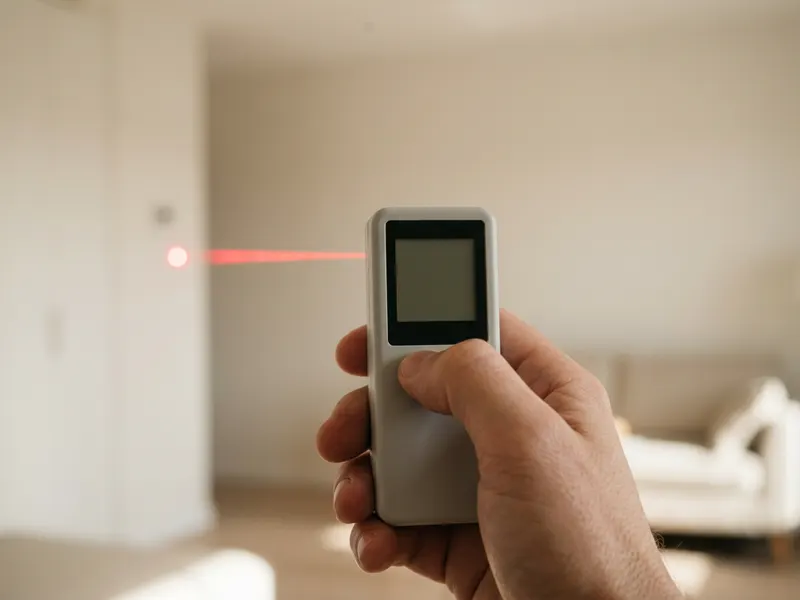 Bosch Blaze Laser Distance Measure
Measure the real diagonal of your deck or frame in one shot and compare it with the 3-4-5 answer.
-
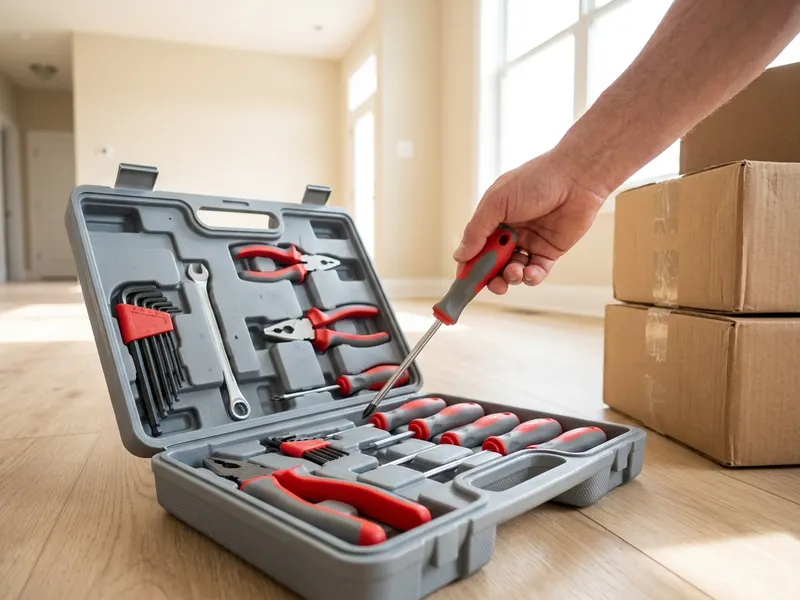 Amazon Basics 142-Piece Home Tool Kit
Square the frame, mark the cut and fasten it down: a starter kit with a tape measure for the job.
Helps keep the tools free. ✨
Images are for illustration only. As an Amazon Associate I earn from qualifying purchases.


