UUID Generator
A random UUID v4 is made the moment the page opens, so you can copy one straight away. Switch to a time-ordered UUID v7 or a short NanoID, make up to 10,000 at once, and set hyphens, capitals and curly braces to match the GUID or UUID style your code or database expects.
How to generate a UUID
- Read the ID in Generated IDs. The line under the box shows how many there are ("1 ID", "5 IDs").
- Press Copy. The button reads "Copied" for a moment. Press Generate new for a fresh set whenever you want one.
- To change the kind of ID or the amount, open Settings and pick a Format and a Quantity.
- For a list, press Download .txt. It saves a plain text file named
uuids.txtwith one ID per line.
Changing Format, Quantity or NanoID length makes new IDs. Hyphens, Uppercase and Curly braces only restyle the IDs already on screen, so you can try them without losing the set you have.
UUID v4 vs UUID v7 vs NanoID
| Format | Example | Characters | Pick it for |
|---|---|---|---|
| UUID v4 (random) | 3b241101-e2bb-4255-8caf-4136c566a962 | 36 | Any unique ID that should reveal nothing |
| UUID v7 (time-ordered) | 0192f5a8-7b3c-7305-8e2d-4f1c9b6a3d10 | 36 | Database primary keys and logs that should sort by time |
| NanoID (short, URL-friendly) | V1StGXR8_Z5jdHi6B-myT | 5 to 36 (default 21) | Short IDs in URLs, file names and slugs |
UUID v4 is 122 random bits plus a few fixed version bits, made with the browser's own crypto.randomUUID(). Nothing in it relates to the time or the machine, which is why it is the default.
UUID v7 follows RFC 9562: the first 48 bits are the Unix time in milliseconds, followed by random bits. Because the timestamp comes first, a newer v7 sorts after an older one. IDs made in the same millisecond, which is every ID in a large batch, are kept in order by a counter, so the list you copy is already sorted:
0192f5a8-7b3c-7305-8e2d-4f1c9b6a3d100192f5a8-7b3c-7306-9b71-c2e4058d1f370192f5a8-7b3c-7307-a3c8-6d90e1f2b45a
Sorted keys matter in a database: random v4 keys scatter new rows across an index, while v7 keys append to the end of it. The trade-off is that the first 12 hex digits show when the ID was created.
NanoID uses the URL-safe alphabet A-Z a-z 0-9 _ - and takes its randomness from crypto.getRandomValues. Set NanoID length from 5 to 36. At 21 characters it has about as much randomness as a v4 UUID in a much shorter string, and each character removed makes a duplicate more likely, so keep short IDs for small sets.
UUID without dashes, uppercase or in braces
The three look options change only the text. Here is one v4 UUID in each style:
| Setting | Result |
|---|---|
| Default | 3b241101-e2bb-4255-8caf-4136c566a962 |
| Hyphens off | 3b241101e2bb42558caf4136c566a962 |
| Uppercase on | 3B241101-E2BB-4255-8CAF-4136C566A962 |
| Curly braces on | {3b241101-e2bb-4255-8caf-4136c566a962} |
Hyphens and Curly braces appear for UUID v4 and v7 only. Uppercase works for all three formats, but on a NanoID it merges each lowercase letter with its capital, which leaves fewer possible characters, so raise the length by a few to compensate.
Generate many UUIDs at once
Enter any whole number from 1 to 10,000 in Quantity and the full list appears in Generated IDs, one per line. Copy copies the whole list as it is shown, with your hyphen, case and brace choices, and Download .txt saves the same list as uuids.txt. Use it to fill a test database, seed a spreadsheet column or prepare IDs for a bulk import. The IDs are made in your browser and are not stored: press Generate new and the old set is gone.
UUID or GUID?
They are the same thing. GUID is the Microsoft name (.NET, SQL Server, the Windows registry) and UUID is the name in the standard, but both are a 128-bit number written as 32 hex digits in the 8-4-4-4-12 pattern. For a GUID the way Windows tools often show it, tick Uppercase and Curly braces. For the lowercase, brace-free form that most languages and databases print by default, leave them off.
What it does not do
This makes identifiers; it does not check or take them apart. There is no validator, no decoder for the timestamp inside a v7 ID, and no UUID v1, v5 or nil UUID. It is also not a sequential key generator for a database: each press makes new, unrelated IDs, and your database or application must store them. Treat IDs as unique labels, not as secrets.
More generators and decoders
For a secret rather than an ID, make one with the Password Generator. For plain numbers use the Random Number Generator, and for whole fake records with IDs, names and emails try the Mock Data Generator. Tokens often carry a UUID in a claim such as jti: read one with the JWT Decoder, or encode and decode text with the Base64 Converter.
Frequently asked questions
How do I generate a UUID online?
A UUID v4 is already shown in Generated IDs when the page loads. Press Copy to take it, or Generate new for a fresh one. Use the Format select in Settings to switch to UUID v7 or NanoID.
What is the difference between a UUID and a GUID?
None in the format. GUID is the name Microsoft uses in .NET, SQL Server and Windows, and UUID is the name in the standard (RFC 9562). Both are 128-bit values written as 32 hex digits in 8-4-4-4-12 groups. For a GUID in the Microsoft style, tick Uppercase and Curly braces.
UUID v4 or v7: which should I use?
Choose v4 when you only need a unique random ID: 122 of its 128 bits are random and it reveals nothing. Choose v7 for database primary keys: it starts with a millisecond timestamp, so new IDs sort after older ones and inserts land at the end of an index instead of all over it. The cost is that a v7 ID shows when it was made.
Can two UUIDs be the same?
In theory yes, in practice no. A v4 UUID has 122 random bits, so you would need to generate about 2.7 quintillion of them before the chance of one duplicate reaches 50%. That is a billion UUIDs every second for roughly 85 years.
How do I generate multiple UUIDs at once?
Type a number from 1 to 10,000 in Quantity. The IDs appear one per line in Generated IDs, with a count under the box. Copy takes the whole list, and Download .txt saves it as uuids.txt with one ID per line.
How do I remove the dashes from a UUID?
Untick Hyphens in Settings. A UUID then becomes 32 characters, for example 3b241101e2bb42558caf4136c566a962. The option appears for UUID v4 and v7 and is not shown for NanoID.
Should a GUID be uppercase or lowercase?
Letter case does not change the value, and the standard text form is lowercase. Tick Uppercase when the place you paste into expects capitals, as Windows registry entries and SQL Server output often do. When you compare IDs, convert both to the same case first.
How do I add curly braces to a GUID?
Tick Curly braces in Settings. Each UUID is wrapped like {3b241101-e2bb-4255-8caf-4136c566a962}, the form used by the Windows registry, COM and some C# and SQL code. It works with or without Hyphens and Uppercase.
Is a UUID secure?
UUID v4 and NanoID are made with the browser's cryptographic random generator, so they cannot be predicted. Still, a UUID is an identifier, not a password: do not rely on it alone to guard data. UUID v7 also contains its creation time, so never use it as a secret.
What is NanoID and how does it compare with a UUID?
A NanoID is a short random ID built from the 64 characters A-Z a-z 0-9 _ and -, so it is safe in a URL. At the default 21 characters it carries about as much randomness as a v4 UUID (126 bits against 122) in 21 characters instead of 36. Choose a length from 5 to 36 in NanoID length.
How many characters is a UUID?
A UUID is 36 characters with hyphens, 32 without them and 38 inside braces. It is always 128 bits.
Are UUID v7 values sortable?
Yes. The first 48 bits are a Unix timestamp in milliseconds, so v7 IDs sort in creation order as plain text. IDs made in the same millisecond, such as a batch, are kept in order by a counter, so a list from one press of Generate new is already sorted.
Are the UUIDs sent anywhere?
No. They are made in your browser and nothing is sent or saved, so the IDs never reach a server.
Recommended
-
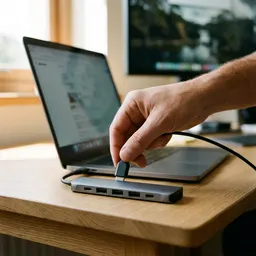 Anker 7-in-1 USB-C Hub
One USB-C port is rarely enough when you also need a monitor and a drive for your test data.
-
 Elgato Stream Deck Neo (8 keys)
Put the "generate a GUID" shortcut on one key and paste it into the next migration.
-
 Samsung T7 Portable SSD (1 TB)
Keep database dumps and seed files you fill with IDs on a fast drive you can plug into any machine.
Helps keep the tools free. ✨
Images are for illustration only. As an Amazon Associate I earn from qualifying purchases.


