Mix Ratio Calculator by Volume
Type a mix ratio as parts, such as 1 and 4 for "1 part to 4 parts", then the total you want to make, and each ingredient's amount appears at once. The result is given in gallons, quarts, cups and fluid ounces or in liters and milliliters, and the unit you enter the total in does not have to be the unit you read the answer in. It handles up to 10 parts and decimals such as 0.5, with no button to press.
How to use the mix ratio calculator
- Under Parts, type each ingredient's share in its number box. The calculator starts with 1 and 4, which is 1 part to 4 parts.
- Optionally type a name in the box next to a number, up to 20 characters, such as Syrup and Water. A blank name shows as Part 1, Part 2 and so on.
- Select Add part for a third, fourth or later ingredient, up to 10. The × button on a row removes it, and at least 2 rows always stay.
- Under Total to make, type how much of the finished mix you want and pick its unit: Gallons (US), Quarts (US), Cups (US), Fluid ounces (US), Liters or Milliliters.
- Under Show amounts in, choose US customary or Metric. This is separate from the unit of the total, so you can enter gallons and read milliliters.
- Read the amounts under You need, one line per ingredient with its name and the amount in bold, and a line such as "5 parts in total" below them.
If any part or the total is empty, zero or negative, the card says "Enter a number above zero for every part and for the total volume" instead of an answer. A new page starts at 1 gallon for a visitor in the United States and 1 liter elsewhere, and the matching US customary or Metric display.
What "1 part to 4 parts" means
A part is a unit of measure you choose, and every ingredient is measured with that same unit. "1 part to 4 parts" therefore has 1 + 4 = 5 parts in total, where the first ingredient is one fifth (20%) of the batch and the second is four fifths (80%). The total decides how big a part is: a total of 1 liter makes each part 200 ml, and a total of 40 fl oz makes each part 8 fl oz.
The calculator does this sum for any set of numbers. It adds up the parts, divides the total volume by that sum to get the size of one part, then multiplies by each ingredient's number. Because it only compares sizes, 2 and 8 give exactly the same answer as 1 and 4.
Example: 1 part to 4 parts in 1 gallon
With the starting numbers, 1 and 4, and Total to make set to 1 in the box and Gallons (US) in the dropdown, the card reads:
| Row | Parts | US customary | Second line | Metric |
|---|---|---|---|---|
| Part 1 | 1 | 3 cups, 1.6 fl oz | 25.6 fl oz | 757 ml |
| Part 2 | 4 | 3 qt, 6.4 fl oz | 102.4 fl oz | 3.028 L, with 3,028 ml beneath |
The US customary view breaks an amount into gallons, quarts, cups and fluid ounces, skipping any that are zero, and adds the plain fluid-ounce total on a second line when the breakdown uses several units. The Metric view shows milliliters, and from 1 liter up it shows liters first with the exact milliliters beneath.
Part 2 = 800 ml
5 parts in total
Mix three or more ingredients
Add a row for each extra ingredient and enter all the numbers the recipe gives. A 4:1:1 recipe is 4, 1 and 1, which makes 6 parts, so with Total to make set to 3 and Cups (US) (24 fl oz), one part is 4 fl oz. In US customary the card shows 2 cups (with 16 fl oz beneath), 4 fl oz and 4 fl oz; switched to Metric it shows 473 ml, 118 ml and 118 ml. Parts do not have to be whole numbers, so 0.5 and 3 for a 500 ml batch gives 71.4 ml and 429 ml.
Gallons, quarts, cups and fluid ounces, or liters and milliliters
The US units are US liquid measures, so a cup is 8 fluid ounces and a gallon is 128, not the larger imperial gallon. These are the values the calculator uses:
| Unit | In fl oz | In milliliters |
|---|---|---|
| 1 gallon (US) | 128 | 3,785 (3.785 L) |
| 1 quart (US) | 32 | 946 |
| 1 cup (US) | 8 | 236.6 |
| 1 fluid ounce (US) | 1 | 29.57 |
| 1 liter | 33.8 | 1,000 |
For converting a single quantity between units, the Measurement Converter and the Cooking Measurement Converter are better suited. To scale a whole recipe up or down, use the Recipe Scaler.
Where part-based mixes come up
Recipes and instructions written in parts turn up wherever a batch has to be made bigger or smaller: drink syrups and cocktails, cleaning and household solutions, liquid fertilizer and garden mixes, paint and epoxy mixed by volume, and brines. The calculator only does the arithmetic. For anything with a safety warning, use the ratio printed on the product label.
What this calculator does not do
- It works by volume only, not by weight. A ratio given in grams or ounces by weight is a different calculation.
- The finished amount is the Total to make. If you already have a fixed amount of one ingredient, such as a bottle of concentrate, and want to know how much to add to it, use the Dilution Ratio Calculator, which takes one known amount.
- It assumes liquids add up to the total. Salt or sugar dissolved in water does not behave that way, so measure the water and add the solid to it.
- It does not tell you what ratio to use or whether a mix is safe, and it has no copy or download button.
Frequently asked questions
What does 1 part to 4 parts mean?
It means four equal parts of the second ingredient for every one equal part of the first, so the mix has 5 parts in total. The first ingredient is 1 of those 5 parts (20%) and the second is 4 of 5 (80%). A part can be any measure, a cup, a scoop or a bottle cap, as long as you use the same one for every ingredient. Enter 1 and 4 under Parts to turn those parts into real amounts.
How much is 1 part vinegar to 4 parts water?
It depends on how much you want to make. For 1 quart in total, 1 part vinegar is 6.4 fl oz and 4 parts water is 25.6 fl oz, which the calculator shows as 3 cups, 1.6 fl oz. For 1 gallon, the vinegar is 25.6 fl oz and the water is 102.4 fl oz. Name the two rows Vinegar and Water, set Total to make, and the amounts are worked out for you.
What is 1 part to 4 parts water in liters?
For every liter you want to make, 1 part to 4 parts water is 200 ml of the first ingredient and 800 ml of water. For 5 liters it is 1 L and 4 L. Set the unit next to Total to make to Liters (or Milliliters) and switch Show amounts in to Metric. Amounts of a liter or more are shown in L with the exact milliliters on a second line.
How do you mix 1 part to 10 parts?
Add up the parts: 1 + 10 = 11, so the first ingredient is 1 of 11 parts, about 9.1% of the batch. For 1 quart in total that is 2.91 fl oz of the first ingredient and 29.1 fl oz of the second. Check how the label writes the ratio, though. Some labels write 1:10 to mean 1 part in 10 parts altogether, which would be 1 and 9 in the calculator. Follow the ratio the product label gives.
How do you calculate a mixing ratio?
Add up all the part numbers to get the total parts, divide the total volume by that number to get the size of one part, then multiply each ingredient's part number by it. For 1:4 and 1 liter, the total is 5 parts, one part is 200 ml, so the amounts are 200 ml and 800 ml. The calculator does these three steps as you type.
How do you calculate a 3 part ratio?
The same way as two parts: add the three numbers, divide the total volume by the sum and multiply. For 4:1:1 and 24 fl oz, the sum is 6, one part is 4 fl oz, so the amounts are 16, 4 and 4 fl oz. Select Add part to get a third row, and you can go up to 10 parts.
What is a 1 to 1 ratio mix?
An equal-parts mix, 1 part of each ingredient, so each makes up half of the total. For 2 cups in total that is 1 cup of each. With three ingredients the equivalent is 1:1:1, a third each. Enter 1 and 1 under Parts, or add a row for the third.
How do I convert parts to ounces?
A part has no size of its own, so first decide the total. Divide the total in fluid ounces by the number of parts in all, then multiply by each ingredient's part number. For 40 fl oz of a 1:4 mix, one part is 8 fl oz, so you need 8 fl oz and 32 fl oz. Set the unit to Fluid ounces (US), or enter any other unit and read the amounts in fl oz.
How much resin and hardener do I mix?
Use the ratio printed on the product and check whether it is by volume or by weight. If it is by volume, such as 1:1 or 2:1, enter those numbers under Parts, name the rows Resin and Hardener, and set Total to make to the volume of the batch. If the ratio is by weight, this calculator will give the wrong amounts.
Is there a mix ratio calculator by weight?
Not here. This calculator works by volume only, in US gallons, quarts, cups and fluid ounces, or liters and milliliters. Equal volumes of two liquids do not weigh the same, so a ratio by volume and a ratio by weight are different recipes. Use this one only when the ratio is given in measures of volume.
Recommended
-
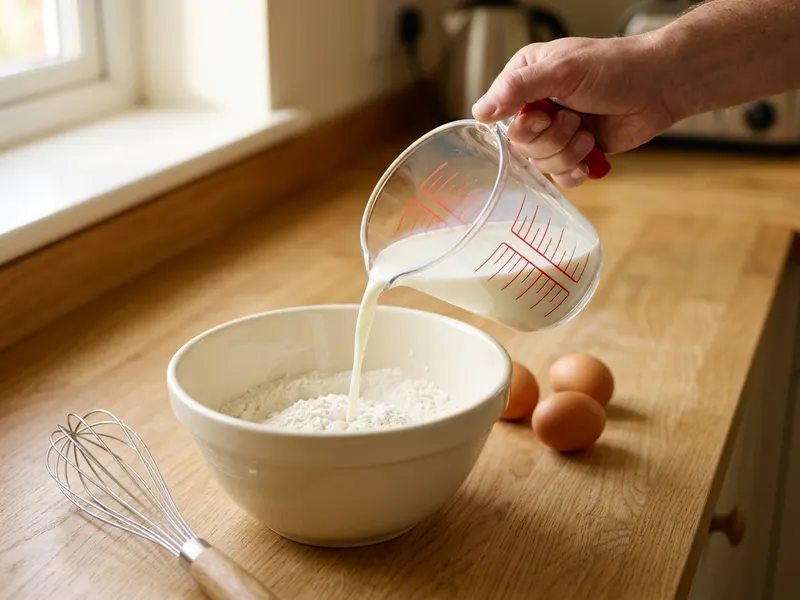 Pyrex Glass Measuring Cup
Pour the exact cups and fl oz the calculator gives you, no eyeballing.
-
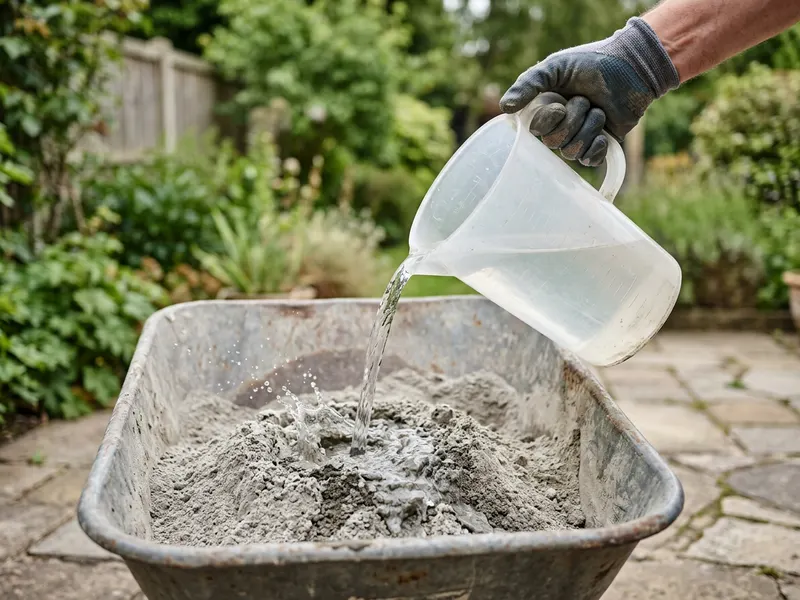 Valley 1-Gallon Measuring Pitcher
A gallon pitcher to mix a full batch of cleaner or syrup in one go.
-
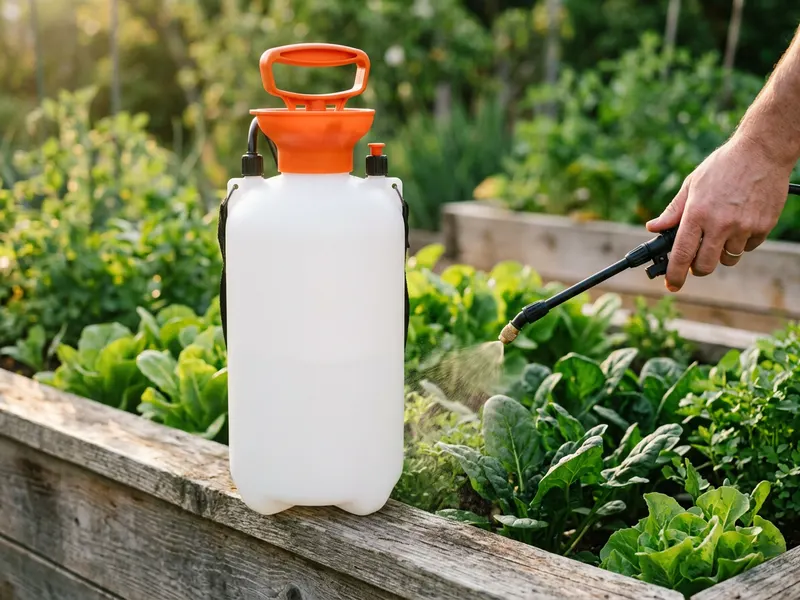 PetraTools EZ1 Battery Sprayer (1 gallon)
Mix a gallon of garden spray at your ratio, then spray it without pumping.
Helps keep the tools free. ✨
Images are for illustration only. As an Amazon Associate I earn from qualifying purchases.


