Password Crack Time Calculator: How Long Would Your Password Take to Crack?
This password crack time calculator estimates how long it would take to guess the password you type, and shows the answer for four kinds of attack: a stolen database stored with a fast or a slow hash, and a login page with or without a limit on tries. It also points out the patterns that make a password easy to guess. The result updates as you type, there is no account, and what you type is not sent or saved anywhere.
How to use the password crack time calculator
- Password - type or paste a password. It is masked as you type; choose Show password to see the characters and Hide password to mask them again.
- Estimated time to crack - the big readout, such as "3 days", "400 years", "Less than a second" or "More than a million years". Beyond a million years it stops counting.
- Strength - five segments that fill from red through orange and yellow to green, with a label: Very weak, Weak, Fair, Strong or Very strong. The gauge and label follow the selected Attack scenario, so one password can read red against one attacker and green against another.
- How to make it harder to guess - the weak patterns found in your password, each with a suggestion. When it finds none, it says "No obvious weak patterns found. Adding length is what makes it harder to crack."
- Attack scenario - choose the attacker the time is worked out for. Stolen database, fast hash is selected to start with.
Only the first 128 characters are checked; if you paste more, the page says so.
Password crack time chart: four passwords, four attackers
The table shows the readout for four made-up example passwords in each Attack scenario. They are examples of how length and patterns change the time, not recommendations.
| Password | Stolen database, fast hash | Stolen database, slow hash | Online login, no limit | Online login, throttled |
|---|---|---|---|---|
password123 | Less than a second | Less than a second | 1 minute | 8 hours |
Dragon2020 | Less than a second | 2 seconds | 25 minutes | 6 days |
x7Kp2mQ9 | Less than a second | 3 hours | 4 months | 114 years |
j4Zq8vLw2nXt5rBc | 12 days | 31,688 years | More than a million years | More than a million years |
Two things stand out. A common password or a word with a year is gone in moments in every case, however many characters it has. And for characters that follow no pattern, each extra character multiplies the time by about ten: the 8 random characters above are counted as 10^8 guesses and the 16 as 10^16.
The four attack scenarios
Each scenario is a guess rate. The time is the number of guesses the estimator expects to need, divided by that rate.
| Attack scenario | Guesses | What it stands for |
|---|---|---|
| Stolen database, fast hash | About 10 billion a second | A leaked list of passwords stored with a quick hash such as MD5 or SHA-1 |
| Stolen database, slow hash | About 10,000 a second | A leaked list stored with a slow hash such as bcrypt or Argon2 |
| Online login, no limit | About 10 a second | A login page that does not slow attackers down |
| Online login, throttled | About 100 an hour | A login page that locks out or slows repeated tries |
You cannot see how a site stores your password, so read the fast hash figure as the cautious one and the others as what you would get if the site did more to protect it.
How long to crack an 8 or 12 character password
Length helps only when the characters follow no pattern. Eight random characters such as
x7Kp2mQ9 show Less than a second against a fast hash. Twelve random characters such as
q8Zr4TmV7wKd show about 2 minutes against a fast hash and about 3 years against a slow one.
But Dragon2020, a word and a year in 10 characters, is found in seconds against a slow hash,
because the estimator knows words, names and years. Type a few of your own styles and watch which
patterns How to make it harder to guess flags.
What the warnings and suggestions mean
The estimator looks for the shortcuts attackers use: common passwords, English words, names, straight rows of keys, repeated characters, sequences like "abc", dates and recent years, and letter swaps such as "@" for "a". Each one it finds becomes a warning, and a suggestion tells you what to avoid. Predictable swaps and a capital first letter add very little, which is why the tips often point to longer passwords with several uncommon words instead. When there is nothing to flag, the page says that adding length is what makes a password harder to crack.
How accurate is the estimate?
The page says it plainly: An estimate, not a promise. Real attackers vary in speed and in what they know about you. The guess count comes from zxcvbn-ts, an open-source estimator with dictionaries of common passwords and English words, names and keyboard layouts. Characters that match none of them are counted as only about ten possibilities each, so a truly random password can be harder than the readout says, while one built from your own name or birthday can be easier. Treat the result as a way to compare passwords and spot weak patterns, not as a guarantee about any account.
The check runs in your browser: What you type is never sent or saved anywhere.
Frequently Asked Questions
How long would it take to crack my password?
Type it into Password and Estimated time to crack shows the answer for the Attack scenario you have chosen. The default, Stolen database, fast hash, is the fastest attack, so it gives the most cautious figure. Switch the scenario to see the slower ones.
How long does it take to crack an 8 character password?
It depends on what the 8 characters are. A common password such as password123 shows Less than a second against both stolen-database scenarios. Eight random characters with no pattern, like x7Kp2mQ9, are counted as about 100 million guesses: Less than a second with a fast hash, about 3 hours with a slow hash and about 4 months against a login with no limit.
How long to crack a 12 character password?
Twelve random characters with no pattern, like q8Zr4TmV7wKd, are counted as about a trillion guesses: about 2 minutes with a fast hash and about 3 years with a slow hash. Length only counts when the characters follow no pattern. Dragon2020 has 10 characters but is a word plus a year, and shows only 2 seconds against a slow hash.
What is the difference between a fast hash and a slow hash?
When a site's password database is stolen, the attacker tests guesses offline against the stored hashes. A quick hash such as MD5 or SHA-1 can be tested at about 10 billion guesses a second in this model, a slow one such as bcrypt or Argon2 at about 10,000 a second. You cannot see which a site uses, so the fast hash is the cautious one to read.
How accurate is a password crack time calculator?
It is an estimate, not a promise. The time is the number of guesses the estimator expects to need, divided by the guess rate of the scenario. Real attackers vary in speed and in what they know about you, and a personal detail such as a name or a pet can make a password easier to find than shown. A truly random password can be harder than shown, because characters with no pattern are counted as only about ten possibilities each.
How secure is my password?
The Strength label, from Very weak to Very strong, and the five-segment gauge sum up how hard the password is to guess for the Attack scenario you have selected, so the same password can read differently under a fast hash and under a throttled login. They are not a verdict that a password is safe: a password reused on several sites, or one that has already leaked, is a risk no estimate can see. How to make it harder to guess lists the patterns that make yours easier to find.
What is zxcvbn and how does it estimate password strength?
zxcvbn is an open-source password-strength estimator. It looks for common passwords, English words and names, keyboard rows, repeats, sequences, dates and letter swaps like @ for a, and counts how many guesses an attacker working through those patterns would need. This page uses zxcvbn-ts, the TypeScript version.
Is my password sent anywhere when I type it in?
No. The check runs in your browser and what you type is never sent or saved anywhere. It is free, with no account. Even so, a sensible habit is to try a password in the same style as yours rather than one you use for important accounts.
Recommended
-
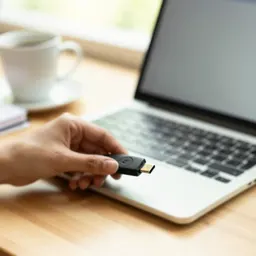 Yubico Security Key C NFC
A strong password can still be phished; a security key makes a stolen one useless.
-
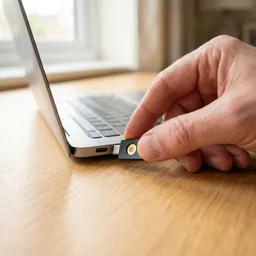 YubiKey 5C NFC Security Key
Works with SSH, passkeys and more for developers; buy two so one is a backup.
-
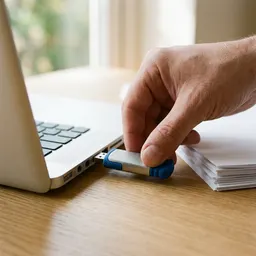 Kingston IronKey Vault Privacy 50 Encrypted USB
Keep password backups and recovery codes on a PIN-locked encrypted drive.
Helps keep the tools free. ✨
Images are for illustration only. As an Amazon Associate I earn from qualifying purchases.


