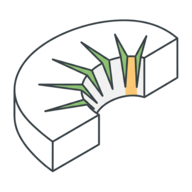
Kerf Bending Calculator
The kerf bending calculator works out exactly how many kerf cuts to make, and how far apart to space them, to bend a board to a target angle and radius. Enter your bend angle, inner radius, material thickness, and blade kerf width, and it instantly returns the cut count and the center-to-center spacing — no more trial-and-error test cuts. Switch between metric (mm) and imperial (inches) with a tap. It runs entirely in your browser — no signup, no app to install, nothing uploaded.
Enter your bend angle, inner radius, material thickness, and blade kerf width in the fields below, and the number of cuts plus the spacing between them update instantly above. Use the toggle to switch between metric and imperial units.
Ready to lay out your cuts? Get the exact count and spacing in one look.
Use the free Kerf Bending Calculator →What Is Kerf Bending?
Kerf bending is a woodworking technique for curving a normally rigid board: instead of steaming or laminating thin strips, you cut a series of closely spaced parallel slots — kerfs — partway through the material. Each kerf leaves a thin, uncut layer behind it. When the board is flexed, those slots open into small wedge-shaped gaps, and the whole piece curves smoothly around a radius. It's a common way to build cabinet toe-kicks, curved signs, skateboard ramps, and other bent-wood parts without specialty equipment — just a table saw or router and some careful spacing.
How to Use the Kerf Bending Calculator (Metric or Imperial)
Four numbers are all it takes, and the result updates as you type — no submit button:
- Open capsuletools.app/kerf-bending-calculator/
- Unit toggle — pick Metric (mm) or Imperial (in) at the top; it only changes how the fields are labeled, so enter every measurement in that same unit
- Bend angle — the final angle of the bend, in degrees (for example 90°)
- Inner radius — the radius of the inside face of the curve
- Material thickness — how thick the board is
- Blade kerf — the width of cut your saw blade removes
The big number is the number of cuts to make; below it are the cut spacing (center-to-center) and the total cut length — the span of board the cuts will cover, measured along the outer face where you're actually cutting from.
Inner radius = 150 mm
Material thickness = 18 mm
Blade kerf = 3 mm
Number of cuts = 10
Cut spacing = 26.389 mm
How Kerf Spacing Is Calculated
As a board bends, its outer face has to travel further around the curve than its inner face — the same reason the outside lane of a running track is longer than the inside lane. That difference is exactly the material the kerf cuts need to remove:
outer arc = 2π × (radius + thickness) × (angle ÷ 360)
total gap = outer arc − inner arc
Dividing that total gap by your blade's kerf width, and rounding up to a whole cut, gives the number of cuts. Dividing the outer arc length by the number of cuts gives the spacing between them, measured center-to-center along the outer face — the face the cuts are actually made from.
Kerf Bending Plywood, MDF & Solid Wood
The geometry above is the same regardless of material, but how deep to cut and how tight a radius you can push differs by material:
| Material | Behavior |
|---|---|
| Plywood | Cross-grain plies flex more evenly; forgiving of tighter radii |
| MDF | No grain to fight, won't splinter — but brittle, so support the bend well |
| Solid / hardwood | Grain direction matters most; space cuts closer for a tight bend |
In every case, cut deep enough that the remaining uncut layer is thin and consistent — typically two-thirds to three-quarters of the total thickness — but not so deep that individual segments snap off rather than flexing.
Tips for a Clean Kerf-Bent Curve
- Cut a test piece from scrap of the same thickness before committing to your final board
- Keep every kerf the same depth — a stop block or router jig is more consistent than eyeballing it
- Flex the board slowly and evenly across a form so no single kerf takes all the stress
- Back the bend with a thin skin or add glue between the closed kerfs to lock the curve in place
Frequently asked questions
What is kerf bending?
Kerf bending is a woodworking technique where a series of closely-spaced parallel saw cuts (kerfs) are made partway through a board, leaving a thin layer of intact material. Each cut opens into a small wedge-shaped gap as the board is flexed, letting a normally rigid piece of wood curve smoothly around a radius — useful for cabinet toe-kicks, curved signs, skateboard ramps, and other bent-wood parts.
What is the formula for kerf bending spacing?
The total material to remove is the difference between the arc length of the outer face and the arc length of the inner face of the bend: outer arc − inner arc, where each arc length is 2π × radius × (angle ÷ 360). Dividing that gap by your blade's kerf width and rounding up gives the number of cuts; dividing the outer arc length by the number of cuts gives the center-to-center spacing.
How do you kerf bend plywood?
Mark the bend's inner radius and angle on the plywood, then use a table saw or router set to a consistent depth — typically two-thirds to three-quarters of the panel's thickness — to make evenly spaced parallel cuts across the bend area. Plywood's cross-grain plies make it more forgiving than solid wood, since each ply doesn't need to flex as far, but keep the remaining uncut layer thin and consistent or the bend will crack unevenly.
How do you kerf bend wood?
Cut a series of parallel slots most of the way through the board — deep enough that a thin skin of wood is left to hold everything together, but not so deep it splits. Space the cuts closer together for a tighter radius and further apart for a gentler curve. Once every cut is made, the board can be flexed by hand around a form or jig; the kerfs close up as the wood bends, and glue or a backing skin is often added afterward to lock the curve in place.
How is kerf bend radius calculated?
The achievable bend radius depends on material thickness, cut spacing, and how deep the kerfs are cut — thinner material and closer-spaced cuts allow a tighter radius. This calculator works the other direction: give it your target inner radius, bend angle, material thickness, and blade kerf, and it returns the exact number of cuts and the spacing needed to hit that radius.
Does this calculator work in metric and imperial units?
Yes — a toggle at the top switches the field labels between Metric (mm) and Imperial (inches). The underlying math is proportional, so it works correctly in either system as long as every field — radius, thickness, and blade kerf — is entered in the same unit.
Can you kerf bend MDF?
Yes — MDF is actually one of the more forgiving materials for kerf bending because it has no grain direction to fight and won't splinter along a cut line the way solid wood can. It's brittle, though, so use closer cut spacing and support the bend well while flexing it to avoid snapping the thin remaining layer.
Use the free Kerf Bending Calculator →
Related tools
Compressed Insulation Calculator
Effective R-value of batt insulation squeezed into a cavity
How Compressed Insulation Calculator works
Conduit Fill Calculator
Conduit fill % calculator — EMT, PVC, Cat6, THHN
How Conduit Fill Calculator works
Fabric Gathering Calculator
Test swatch → flat fabric to cut for gathers & ruffles
How Fabric Gathering Calculator works

Break-Even Calculator
Fixed & variable costs + price → break-even point + chart
How Break-Even Calculator works