IBU Calculator for Homebrew Hop Additions
Enter your batch volume, original gravity and each hop addition, and the calculator shows the beer’s Total bitterness in IBU along with the IBU each hop contributes. It uses the Tinseth formula by default, or Rager if you prefer, in US gallons and ounces or in liters and grams. It is an estimate for planning a recipe, not a lab reading.
How to calculate IBU from your hop additions
- Fill in the batch: Batch volume (the finished volume you are aiming for, in gallons or liters) and Original gravity (OG), between 1.000 and 1.200. A typical pale ale is around 1.050.
- Under Hop additions, fill in Hop 1: its Weight (oz or g), its Alpha acid percentage from the package (0.1 to 30) and its Boil time in minutes (0 to 120), counted from when the hop goes in until the end of the boil.
- Press Add hops for each further addition and fill in the same three boxes. Each row shows its own IBU, and the X button at the end of a row removes it (the last row stays).
- Read Total bitterness at the top. It is the sum of the rows and updates as you type, with no Calculate button.
- Press the Units & formula gear button to change the Unit system (US (gal, oz) or Metric (L, g)) or the Formula (Tinseth or Rager). Switching units converts the values you have already typed.
A row that is blank or outside the ranges above is marked and left out of the total, so a half-typed hop never produces a wrong number.
Example: a bittering hop plus a late addition
A 5-gallon batch at OG 1.050 with two additions:
| Row | Weight | Alpha acid | Boil time | Tinseth | Rager |
|---|---|---|---|---|---|
| Hop 1 | 1 oz | 5.5 % | 60 min | 19.0 IBU | 25.3 IBU |
| Hop 2 | 0.5 oz | 10 % | 15 min | 8.6 IBU | 6.1 IBU |
| Total bitterness | 27.6 IBU | 31.4 IBU |
The same recipe lands about 4 IBU apart depending on the formula, which is why you should pick one and stay with it when you compare recipes.
Tinseth or Rager: which formula to use
Both turn alpha acid into IBU through a utilization figure, the share of the hop’s alpha acid that ends up as bitterness in the beer. They disagree most on the extremes of boil time. The table uses 1 oz of 5.5 % hops in 5 gallons at OG 1.050:
| Boil time | Tinseth | Rager |
|---|---|---|
| 0 min | 0.0 IBU | 4.2 IBU |
| 15 min | 9.4 IBU | 6.8 IBU |
| 30 min | 14.6 IBU | 14.0 IBU |
| 60 min | 19.0 IBU | 25.3 IBU |
| 90 min | 20.3 IBU | 26.2 IBU |
- Tinseth is the default and the usual choice for homebrew recipes. Utilization climbs steadily with boil time and drops as the wort gets stronger.
- Rager follows an S-shaped curve, so it reads lower than Tinseth on short additions and higher on long boils (past roughly 30 minutes here). It corrects for gravity only above 1.050, and less sharply than Tinseth does: at OG 1.080 a 60-minute addition is 14.5 IBU in Tinseth and 22.0 in Rager.
If a recipe was written with a particular formula, use the same one here so your numbers match the author’s.
How the IBU formulas work
Both formulas start with how much alpha acid is in the kettle per unit of volume, then multiply by a utilization factor.
- Alpha acid in the batch: ounces × alpha acid × 7490 ÷ gallons gives milligrams per liter (grams × alpha acid × 1000 ÷ liters in metric; the calculator converts metric to US units first).
- Tinseth utilization: a gravity factor of 1.65 × 0.000125(OG − 1) times a time factor of (1 − e−0.04 × minutes) ÷ 4.15.
- Rager utilization: 18.11 + 13.86 × tanh((minutes − 31.32) ÷ 18.27) percent, with the total divided by 1 + (OG − 1.050) ÷ 0.2 when OG is above 1.050.
What this IBU calculator leaves out
These formulas model a boil, and the answer is only as good as the numbers you enter. Dry hops are not modelled and should be left out. Whirlpool and flameout additions can be entered as a hop with the whirlpool minutes, but the formulas have no temperature input, so a cooler whirlpool makes less bitterness than shown. Real bitterness also shifts with hop age (the alpha acid on the package is for fresh hops), pellets versus whole cones, kettle shape and how hard the boil is. Use the total to compare recipes and plan changes, then adjust by taste.
The calculation happens on your device and nothing you enter is uploaded or saved. Once the bitterness is where you want it, the ABV Calculator works out the strength of the same beer from your OG and FG readings.
Frequently asked questions
How do you calculate IBU in beer?
For each hop addition, multiply the alpha acid you put in the batch (ounces times alpha acid percent times 7490, divided by gallons, gives milligrams per liter) by a utilization figure that depends on boil time and wort gravity. Add the additions together for the total. The calculator does this on every keystroke: enter Batch volume, Original gravity (OG), then Weight, Alpha acid and Boil time for each hop. Tinseth is the default formula.
What does IBU mean in beer?
IBU stands for International Bitterness Units, a scale for how bitter a beer is. One unit is roughly one milligram of bittering compounds (iso-alpha acids from the hops) per liter of beer. Light lagers often sit around 10 to 20 IBU, pale ales around 30 to 45, and IPAs from 40 to well over 60. Your tongue also reacts to sweetness and malt, so the same IBU can taste more or less bitter in different beers.
What is the difference between Tinseth and Rager IBU?
They use different utilization curves. Tinseth rises smoothly with boil time and shrinks as the wort gets stronger. Rager uses an S-shaped curve with a gravity correction only above 1.050. For one ounce of 5.5 percent hops in 5 gallons at OG 1.050, a 60-minute addition reads 19.0 IBU with Tinseth and 25.3 with Rager, while a 15-minute addition reads 9.4 with Tinseth and 6.8 with Rager. Rager also gives a few IBU to a 0-minute addition; Tinseth gives zero.
How do I calculate IBU for a whirlpool or hop stand?
Add a hop row and type the whirlpool minutes into Boil time. Neither formula has a temperature input, so it treats those minutes as if the wort were boiling. A whirlpool at 80 C or below makes less bitterness than a boil of the same length, so read the number as an upper estimate.
Do dry hops add IBU?
Dry hops go into cold beer and are never boiled, so these formulas give them no bitterness, and the calculator does not model them. Leave them out. Do not enter a dry hop as a 0-minute addition: Tinseth shows 0 for it, but Rager would add a few IBU that the hop does not really contribute.
Is there an IBU calculator in metric?
Yes. Open the settings gear and set Unit system to Metric (L, g), and Batch volume becomes liters and each hop Weight becomes grams. The numbers you already typed are converted when you switch, and both unit systems give the same IBU for the same beer. For example, 28 g of 5.5 percent hops boiled 60 minutes in 20 liters at OG 1.050 gives 17.8 IBU with Tinseth, a little below 1 oz in 5 gallons because 20 liters is more than 5 gallons.
How do you measure IBU in homebrew?
Measuring IBU needs a lab: a sample is tested for its bittering compounds with a spectrophotometer or similar equipment, which few homebrewers have. Most homebrewers estimate with a formula like this one and then adjust the recipe by taste. Treat the estimate as a guide for comparing recipes, not as a lab result.
Recommended
-
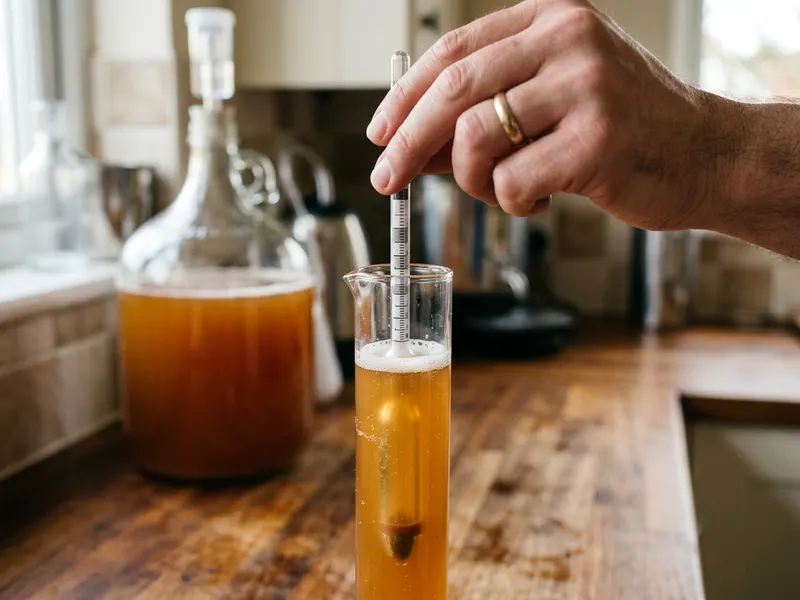 SOLIGT Triple-Scale Hydrometer + Test Jar
Measure your real original gravity before you enter it, so the IBU matches the beer in the fermenter.
-
 Etekcity Digital Kitchen Scale
Weigh each hop addition to the gram so the weights you typed in are the weights that go in the pot.
-
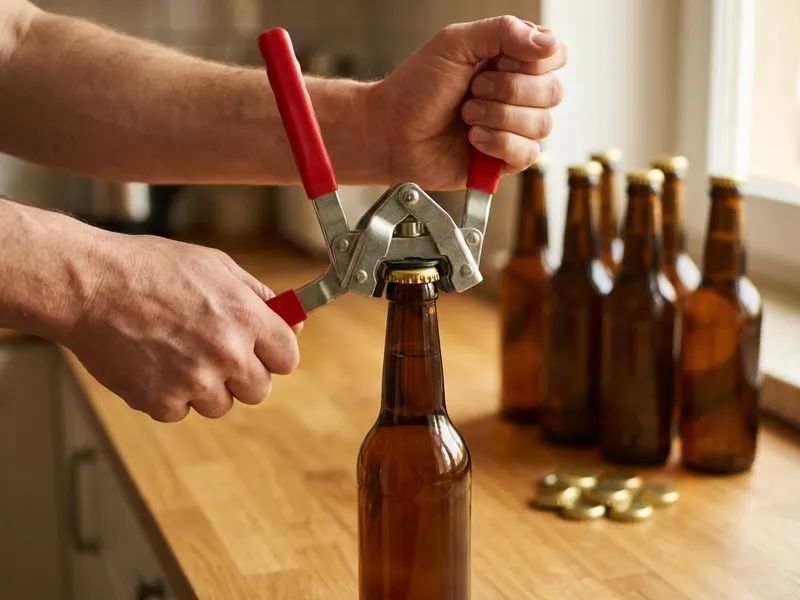 Bottle Capper + 150 Crown Caps
Once the bitterness is dialed in and the beer has fermented, cap your bottles yourself.
Helps keep the tools free. ✨
Images are for illustration only. As an Amazon Associate I earn from qualifying purchases.


