Brewing Water Calculator: Salt Additions and Mash pH
Type in your water report, say how much water and grain you are mashing, and pick a target profile. Then enter grams of gypsum, calcium chloride, Epsom salt, table salt or baking soda, and millilitres of lactic or phosphoric acid, and watch the finished water and your estimated mash pH change. Everything updates as you type, and nothing leaves your device.
How to use the brewing water calculator
- Source water. Enter the ppm values from your water report: Calcium (Ca), Magnesium (Mg), Sodium (Na), Chloride (Cl), Sulfate (SO₄) and Alkalinity (as CaCO₃). For reverse osmosis or distilled water, leave every box empty.
- Water and grain. Choose Metric (L, kg) or US (gal, lb), then fill in Mash water, Sparge water, Grain weight and Average grain color, in °L or SRM. If your maltster gives EBC, multiply by 0.508 to get SRM.
- Target water. Pick a Target profile, for example Hoppy or Dark and malty. To aim for your own numbers, switch on Custom target and type the five mineral values.
- Salts and acid. Enter grams of each salt and, if you want one, choose an Acid and type the Acid amount in mL. The amounts are dissolved in all the water, mash and sparge, split by volume.
- Check the result. The panel at the top always shows Estimated mash pH and the finished water. The Final water vs. target table lists Mineral, Final, Target and Diff, so you can nudge a salt until the differences are small.
- Save it. Copy summary puts a plain-text list of your additions, final water and pH on the clipboard. Copy link copies a web address that holds the whole recipe after the #, so opening it restores every field.
What each brewing salt adds
The mineral figures are straight stoichiometry: the share of each salt that is the ion, spread over the volume of water. This is how much 1 gram of each salt adds, in ppm:
| Salt | In 1 US gallon | In 1 litre |
|---|---|---|
| Gypsum (CaSO₄) | 61.5 Ca, 147.4 SO₄ | 232.8 Ca, 557.9 SO₄ |
| Calcium chloride (CaCl₂, dihydrate) | 72.0 Ca, 127.4 Cl | 272.6 Ca, 482.3 Cl |
| Epsom salt (MgSO₄) | 26.1 Mg, 103.0 SO₄ | 98.6 Mg, 389.7 SO₄ |
| Table salt (NaCl) | 103.9 Na, 160.2 Cl | 393.4 Na, 606.6 Cl |
| Baking soda (NaHCO₃) | 72.3 Na, 157.4 alkalinity | 273.7 Na, 595.7 alkalinity |
Gypsum pushes sulfate up and gives a crisp, dry finish. Calcium chloride pushes chloride up for a softer, fuller one. Both raise calcium. Epsom salt and table salt are for small corrections of magnesium and sodium, and baking soda adds alkalinity.
Target water profiles
The presets are common published starting points, in ppm. They say where to aim, not what is correct.
| Target profile | Ca | Mg | Na | Cl | SO₄ |
|---|---|---|---|---|---|
| Light and crisp | 50 | 5 | 5 | 40 | 50 |
| Balanced | 100 | 10 | 15 | 80 | 100 |
| Hoppy | 140 | 10 | 15 | 60 | 300 |
| Soft and juicy (hazy IPA) | 130 | 10 | 15 | 180 | 80 |
| Malty | 90 | 10 | 15 | 120 | 60 |
| Dark and malty (stout, porter) | 80 | 10 | 20 | 100 | 60 |
| Burton (classic English bitter) | 295 | 45 | 55 | 25 | 725 |
Sulfate to chloride ratio and residual alkalinity
Under the comparison table you get two numbers that brewers watch. Sulfate : chloride is a rough guide to balance: above 1 leans crisp and hoppy, below 1 leans soft and malty. Residual alkalinity is alkalinity − (Ca ÷ 1.4 + Mg ÷ 1.7), all in ppm. The higher it is, the more the water pushes mash pH up, and a negative value pulls it down.
How the mash pH estimate works
The estimate starts from the pH a mash would have in distilled water, which falls as the grain gets darker (about 5.70 for a very pale grist). It then shifts that figure by the residual alkalinity of your finished water and by any acid, divided by the grain's buffering, assumed to be about 40 milliequivalents per kg per pH unit. The note under the number tells you whether it is below, in or above the usual 5.2–5.6.
This is an estimate for homebrewing. Real malt buffers differently from batch to batch, so check your actual mash pH with a calibrated meter and adjust from there.
Once the beer is fermented, work out its strength with the ABV calculator.
Frequently asked questions
How do I lower mash pH?
Add acid or cut the alkalinity of the water. In the Acid box, pick Lactic acid 88% or Phosphoric acid 10%, type an amount in mL and watch Estimated mash pH fall. Calcium also helps: gypsum or calcium chloride raise Ca, which pulls residual alkalinity down. Dark grain lowers mash pH on its own, and very hard, alkaline source water is the usual reason a pale mash lands too high.
How much lactic acid do I need to lower mash pH?
It depends on your water's alkalinity, the water volume and the grain, so there is no single number. Enter your source water, volumes and grain, choose Lactic acid 88%, and raise Acid amount a little at a time until Estimated mash pH sits in the 5.2–5.6 range. The calculator treats each mL of 88% lactic acid as about 11.5 milliequivalents of acid. Confirm the result with a calibrated pH meter.
How much phosphoric acid do I need to lower mash pH?
Phosphoric acid 10% is much weaker than 88% lactic acid, so you need roughly ten times the volume for the same effect. The calculator counts about 1.09 milliequivalents per mL. Choose Phosphoric acid 10%, raise Acid amount in mL until Estimated mash pH is where you want it, and check with a meter.
Does baking soda raise mash pH?
Yes. Baking soda (NaHCO₃) adds sodium and bicarbonate alkalinity, which pushes mash pH up. It is mainly useful for dark beers brewed with soft water, where the grain is acidic and the mash pH can land too low. Enter grams in the Baking soda (NaHCO₃) box and the Alk figure and Estimated mash pH both rise.
What is a good sulfate to chloride ratio for beer?
There is no single right ratio. Sulfate above chloride (a ratio above 1) leans crisp, dry and hoppy; chloride above sulfate (below 1) leans soft, full and malty. The preset targets here run from about 0.4 for a soft, juicy IPA to about 5 for a hoppy beer and about 29 for Burton. The Sulfate : chloride line under the comparison table shows your current ratio.
Can I brew beer with distilled or RO water?
Yes. Distilled and reverse osmosis water are a blank slate with almost no minerals, so you build the profile from salts. Leave the Source water boxes empty (they count as zero), pick a Target profile, then add Gypsum, Calcium chloride and the other salts until the Final water vs. target table is close.
What is a hazy IPA water profile?
Hazy IPAs usually aim for more chloride than sulfate for a soft, full mouthfeel. The Soft and juicy (hazy IPA) preset targets 130 ppm calcium, 10 magnesium, 15 sodium, 180 chloride and 80 sulfate, a sulfate to chloride ratio of about 0.44. Treat it as a starting point, not a rule.
What is the Burton water profile?
Burton-on-Trent water is very high in calcium and sulfate, which gives the dry, sharp bitterness of classic English pale ales. The Burton (classic English bitter) preset targets 295 ppm calcium, 45 magnesium, 55 sodium, 25 chloride and 725 sulfate. That much sulfate is harsh in many beers, so it suits only that style.
How accurate is the estimated mash pH?
It is an estimate, not a measurement. The salt amounts are exact chemistry, but mash pH also depends on your malt's own buffering, which varies by maltster and batch. The calculator assumes about 40 milliequivalents per kg of grain per pH unit. Use it to plan, then confirm the real mash pH with a calibrated meter about 10 to 15 minutes into the mash.
Recommended
-
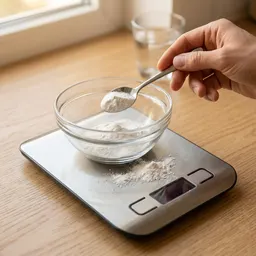 Etekcity 0.1 g Digital Kitchen Scale
Weigh your gypsum and other salt additions to the tenth of a gram.
-
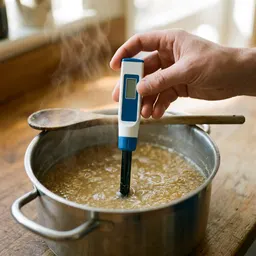 Apera PH60 Pocket pH Tester
Check your real mash pH against the estimate.
-
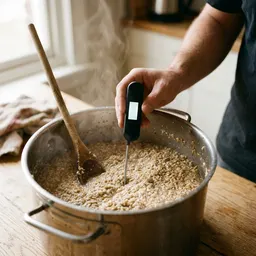 Amazon Basics Instant-Read Thermometer
Keep your mash at the temperature you planned.
Helps keep the tools free. ✨
Images are for illustration only. As an Amazon Associate I earn from qualifying purchases.


