Fermentation Salt Calculator
A fermentation salt calculator that works from weight. Enter the weight of your cabbage, flour, meat or other solids, add any brine or dough water, set the share of salt you want, and Salt to add shows the grams or ounces to weigh out. It also lists that salt as teaspoons and tablespoons for table salt and two kosher brands.
How to Calculate Salt for Fermenting by Weight
Fermenting recipes describe salt as a percentage of weight, because spoons of salt vary so much between brands. The sum is simple: (ingredient + water) × percentage ÷ 100. Type your numbers into the fields and the answer updates as you go, with no calculate button.
- Pick Metric (g) or Imperial (oz). Anything already typed converts when you switch.
- Enter Ingredient weight: the cabbage, flour, meat or other solids.
- Optionally enter Water weight (optional): brine or dough water. Leave it blank for none.
- Set Target salt percentage. It starts at 2, a common figure for sauerkraut. A decimal comma such as 2,5 works too.
- Read Salt to add, shown to two decimals.
Example: Salt for Sauerkraut Per Kilo of Cabbage
A sauerkraut salt calculator is the most common use. Shredded cabbage makes its own brine, so there is usually no water to add.
Ingredient weight: 1000 g · Water weight: blank · Target salt percentage: 2
1000 × 2 ÷ 100 = 20 g of salt
In imperial: 2 lb (32 oz) at 2% = 0.64 oz
That 20 g is about 1 tbsp + ⅜ tsp of table salt, but a different amount of Diamond Crystal, which is why the spoon list is there.
Salt Percentage Starting Points for Ferments, Brines and Meat
These are commonly used starting points, not rules. Your recipe, your ingredients and your taste decide the final number, so follow a tested recipe where one exists. Grams of salt per 1,000 g of total weight:
| Use | Common range | Salt per 1,000 g |
|---|---|---|
| Dry brine for meat | 1–1.5% | 10–15 g |
| Sauerkraut and shredded vegetables | about 2% | about 20 g |
| Kimchi | 2–3% | 20–30 g |
| Brine for pickles | 3–5% | 30–50 g |
Salt for a Brine, a Dry Brine or Bread Dough
Brine. To make a salt brine of a set strength, enter the water weight as Ingredient weight, leave Water weight (optional) blank, and type the percentage. 1,000 g of water at 3% needs 30 g of salt. To salt a jar of vegetables and brine together, put the vegetables in Ingredient weight and the liquid in Water weight (optional), and the percentage applies to the whole jar.
Dry brine. Enter the weight of the meat and a low percentage, often 1 to 1.5%. 2,000 g of meat at 1% needs 20 g.
Bread. Baker's percentage is measured against the flour only, while this tool uses the total of ingredient plus water. For a baker's-percent figure, enter just the flour as Ingredient weight, leave the water blank, and type the percentage: 500 g of flour at 2% is 10 g of salt.
Table Salt vs Kosher Salt by the Spoon
The Or measure it by spoon list turns the same weight of salt into teaspoons and tablespoons, rounded to the nearest 1/8 tsp. The three salts weigh very differently per level teaspoon:
| Salt | Grams per level teaspoon |
|---|---|
| Table salt | 6.0 g |
| Morton Kosher | 4.8 g |
| Diamond Crystal Kosher | 2.8 g |
Morton and Diamond Crystal are both US brands, and densities differ by brand, grind and how you fill the spoon. If you use another salt, open Use your own salt, enter the grams in one level teaspoon under Custom salt density, and a Your salt row joins the list. Weighing on a kitchen scale is still the most reliable way.
Sodium Content of Your Salt
Open Sodium content to see the milligrams of sodium in the salt you are adding. It is estimated from table salt being 39.34% sodium by weight, which is 393.4 mg per gram: 20 g of salt is 7,868 mg of sodium.
Your Numbers Stay in Your Browser
The sum is worked out in your browser as you type. Nothing is uploaded or saved, and there is no account.
Frequently Asked Questions
How much salt do you use in sauerkraut?
A common starting point is about 2% of the cabbage weight: 20 g of salt for every 1,000 g of shredded cabbage. Weigh the cabbage, leave Water weight (optional) blank because sauerkraut makes its own brine, keep Target salt percentage at 2, and Salt to add shows the grams. Many recipes sit between 1.5% and 2.5%, so follow your own recipe if it names a number.
What percentage of salt is used for fermenting vegetables?
Commonly used starting points are about 2% of the total weight for sauerkraut and shredded vegetables, 2 to 3% for kimchi, and roughly 3 to 5% for a pickle brine poured over whole vegetables. Lower percentages ferment faster and taste milder, higher ones slow things down and taste saltier. This calculator applies whatever percentage you type to the combined weight of ingredient and water.
How much salt do I need for kimchi?
Recipes usually land between 2 and 3% of the total weight. Enter the weight of the vegetables as Ingredient weight, add any brine or paste water as Water weight (optional), set Target salt percentage to the figure your recipe uses, and read Salt to add. Coarse kimchi salt and fine salt weigh very differently per spoon, so weigh it rather than measuring by spoon.
How do I work out the salt for a brine?
Weigh the water, enter it as Ingredient weight, leave Water weight (optional) blank, and type the percentage you want, for example 3 for a 3% brine. A litre of water weighs 1,000 g, so 3% is 30 g of salt. If you are brining vegetables in the liquid, put the vegetables in Ingredient weight and the liquid in Water weight (optional) to salt the whole jar by total weight.
How much salt should I use to dry brine meat?
Common starting points are about 1 to 1.5% of the meat weight, which is roughly 10 to 15 g per kilogram. Enter the meat weight as Ingredient weight, leave Water weight (optional) blank, and set Target salt percentage to 1 or 1.5. Larger cuts and longer rests often use the lower end, so adjust to your recipe and taste.
Is this a baker's percentage calculator?
Not exactly. Baker's percentage is measured against the flour alone, while this tool takes a percentage of the total weight of ingredient plus water. For a baker's-percent figure, enter only the flour as Ingredient weight, leave Water weight (optional) blank, and enter the baker's percentage, such as 2, in Target salt percentage. If you also fill in the water, the percentage is applied to flour and water together.
Can I swap table salt for kosher salt?
Only by weight. A level teaspoon holds about 6.0 g of table salt, about 4.8 g of Morton Kosher and about 2.8 g of Diamond Crystal Kosher, so the same spoon can hold twice as much of one salt as another. Use the Or measure it by spoon list to see the same weight of salt as spoons of each type. Densities vary by brand and grind, so weigh when you can.
How do I convert grams of salt to teaspoons?
Divide the grams by the weight of one level teaspoon of your salt. The Or measure it by spoon list does this for Table salt (6.0 g per teaspoon), Morton Kosher (4.8 g) and Diamond Crystal Kosher (2.8 g), rounded to the nearest 1/8 teaspoon. For another salt, open Use your own salt, enter its grams per level teaspoon in Custom salt density, and a Your salt row appears.
Does the calculator send my numbers anywhere?
No. The sum is worked out in your browser as you type, and nothing is uploaded or saved.
Recommended
-
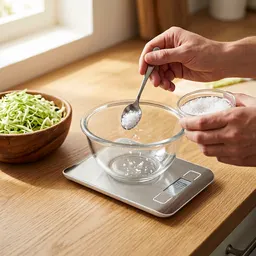 Etekcity 0.1 g Digital Kitchen Scale
Weigh your salt to a tenth of a gram.
-
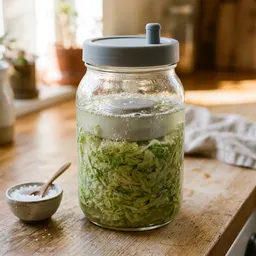 Kilner 1 L Fermentation Jar Set
Jar, lid and weights for a small batch of sauerkraut.
-
 Amazon Basics Instant-Read Thermometer
Check the roast once it has been brined.
Helps keep the tools free. ✨
Images are for illustration only. As an Amazon Associate I earn from qualifying purchases.


