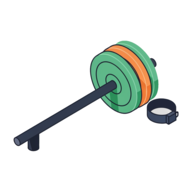
Barbell Plate Calculator
This barbell plate calculator turns a target weight into the exact plates to load on each side of the bar. Type what you want on the rack — in lb or kg — and it subtracts the bar, halves the rest, and shows the fewest plates that get you there, drawn on a barbell sleeve so you can check it at a glance. You can set your own bar weight and switch off any plate size your gym doesn't stock, so the answer matches the rack you're actually standing at. It runs entirely in your browser, with no signup and nothing uploaded.
Type your target weight in the box above and tap lb or kg. The green chips are the plates for one side — put the same on the other. Open Bar & plate rack to change the bar weight or switch off plate sizes your gym doesn't have.
Know your target weight? Get the plates per side in one tap.
Use the free Barbell Plate Calculator →How the Barbell Plate Calculator Works
Loading a bar is three bits of arithmetic you have to do while someone waits for the rack: subtract the bar, halve what's left, then break that number into the plates hanging in front of you. This weight plate calculator does all three the moment you type a number.
The last step is the one that trips people up, and it's why a simple "take the biggest plate that fits" approach isn't good enough. With only 45s, 35s and 25s on the rack and 60 lb to load a side, grabbing a 45 first strands you 15 lb short with nothing to fill it — the answer is a 35 and a 25. This tool searches every combination your rack can actually build and returns the one with the fewest plates, so it never leaves you stuck mid-load.
How to Load a Barbell: Reading the Plates and the Sleeve
- Open capsuletools.app/barbell-plate-calculator/
- Type your target weight — the whole thing, bar included, exactly as you'd write it in a log
- Tap lb or kg — switching converts the number you already typed, so you can read a kilo program in pounds
- Read the green chips — each one is a plate size and how many of it, for one side of the bar
- Check the drawing — the sleeve shows those plates in loading order, heaviest against the collar, exactly how they go on
- Mirror it — the other sleeve gets the same plates; the summary confirms per side, bar, and total
Loading heaviest-first isn't cosmetic. The big plates belong against the inside collar where the sleeve is strongest and the bar sits level on the J-hooks, and it means you can strip weight between sets by pulling the small plates off the end without unloading the whole side.
225 − 45 = 180 lb of plates
180 ÷ 2 = 90 lb per side
Per side: 45 × 2 → "two plates"
Plates Per Side Chart — 135, 225, 315 and 405 lb
The classic gym milestones on a 45 lb bar with 45 lb plates. When lifters say "two plates" they mean two 45s per side, not two plates in total:
| Total | Per side | Plates per side |
|---|---|---|
| 95 lb | 25 lb | 25 |
| 135 lb | 45 lb | 45 — "one plate" |
| 185 lb | 70 lb | 45 + 25 |
| 225 lb | 90 lb | 45 × 2 — "two plates" |
| 275 lb | 115 lb | 45 × 2 + 25 |
| 315 lb | 135 lb | 45 × 3 — "three plates" |
| 365 lb | 160 lb | 45 × 3 + 25 |
| 405 lb | 180 lb | 45 × 4 — "four plates" |
Each extra 45 a side adds 90 lb to the bar, which is why the milestones march up in nineties from 135. In a kilo gym the same ladder runs 60, 100, 140, 180 and 220 kg on a 20 kg bar with 20 kg plates.
Setting Your Bar Weight and Plate Rack (kg or lb)
Open Bar & plate rack and the answer stops being generic. Used as a weight plate calculator in kg or in lb the setup is identical — flip the unit toggle and every preset relabels itself. Two things live there:
- Empty bar — 45, 35, 25 or 15 lb (20, 15, 10 or 7 kg), or Custom for a safety squat, trap, axle, EZ-curl or a bare Smith-machine carriage
- Plates you have — tap any size off and the load is rebuilt without it; tap the micro plates on if you own them
The plate list covers 100 down to 0.25 lb and 25 down to 0.25 kg. A commercial gym's usual set is on by default — 45/35/25/10/5/2.5 lb, or 25/20/15/10/5/2.5/1.25 kg — but plenty of racks are missing 35s, and plenty of home gyms don't have anything under 5 lb. Turn off what you don't have and the calculator will never hand you a plate you'd have to go and find.
One thing worth knowing about bar weights: a "45 lb" bar and a 20 kg bar are treated as the same bar in every gym, but 20 kg is actually 44.09 lb. Bars are manufactured to one standard or the other, so if you're chasing an exact number, weigh yours or check the maker's spec and enter it as a custom bar weight.
When Your Target Weight Can't Be Made Exactly
Plenty of numbers simply aren't loadable. With a standard pound rack the smallest jump you can make is 5 lb — a 2.5 on each side — so anything ending in an odd pound is off the grid. Rather than refuse, the calculator loads the closest weight it can actually build and says how far off it landed: ask for 187 lb and you get 185 lb with a note that it's 2 lb under.
That's also the fastest way to see what micro plates buy you. Switch on the 1.25s and the same rack makes 187.5 lb exactly. For the small week-to-week jumps that keep a linear program moving — 2.5 lb or 1 kg on the bar — a pair of fractional plates is the difference between progressing and stalling, and this is where you can see it before you buy any.
Where a tie is possible, it always rounds down. You asked for a number; it won't quietly hand you a heavier bar than the one you planned to lift.
Everything Stays on Your Phone
There's no account, no upload, and nothing is stored. As a gym plate calculator the whole thing runs in your browser, which also means it keeps working on the flaky signal at the back of a gym once the page has loaded. Add it to your home screen and it opens like an app.
It's arithmetic, not coaching: the tool tells you what to put on the bar, not what you should be lifting. Load the same plates on both sides, use collars, and don't chase a number your setup or your spotter can't handle.
Frequently asked questions
How many plates on each side is 225?
Two 45 lb plates per side, on a standard 45 lb Olympic bar. That is 45 + 45 = 90 lb on each sleeve, 180 lb of plates in total, plus the 45 lb bar itself for 225 lb. This is where the gym shorthand comes from: lifters call 225 "two plates", meaning two 45s a side, not two plates in total.
How many plates on each side is 315?
Three 45 lb plates per side on a 45 lb bar: 135 lb a sleeve, 270 lb of plates, plus the bar for 315 lb. In gym shorthand that is "three plates". The pattern is simply 45 lb of bar plus 90 lb per extra pair, so each additional 45 a side adds 90 lb to the total.
How many plates on each side is 405?
Four 45 lb plates per side on a 45 lb bar: 180 lb a sleeve, 360 lb of plates, plus the bar for 405 lb — "four plates". Many bars only hold five or six 45s per sleeve before you run out of collar space, which is where 55 lb or 100 lb plates come in; switch them on in the plate rack and the calculator will use them.
How much weight is 2 plates on each side?
On a 45 lb bar with 45 lb plates, two plates a side is 225 lb total. In a kilo gym the same phrase means two 20 kg plates a side on a 20 kg bar, which is 100 kg. "Plates" always means the big ones — 45 lb or 20 kg — and always per side, so the total is bar weight plus four times the plate weight.
Do you include the weight of the bar?
Yes. The target weight you type is the total on the rack, bar included, which is how lifts are recorded and how programs are written. The calculator subtracts the bar first, halves what is left, and loads that on each sleeve. If you set the bar to 45 lb and ask for 225 lb, it gives you 90 lb a side — not 112.5.
What if my target weight can't be made exactly with the plates I have?
The calculator loads the closest weight it can actually build and tells you how far over or under it lands. Asking for 187 lb with a standard rack gets you 185 lb and a note saying it is 2 lb under. Turning on the micro plates — 1.25, 1, 0.5 or 0.25 — usually closes the gap; with 1.25s available the same rack makes 187.5 lb exactly.
How much does an Olympic barbell weigh?
A men's Olympic barbell is 20 kg, sold in the US as 45 lb — the two are not identical (20 kg is 44.09 lb) but gyms treat them as the same bar. A women's Olympic bar is 15 kg or 35 lb, training bars are usually 10 kg or 25 lb, and youth bars around 7 kg or 15 lb. All four are presets, and you can type an exact weight for a specialty bar such as a safety squat, trap or axle bar.
Use the free Barbell Plate Calculator →
Related tools

Fabric Gathering Calculator
Test swatch → flat fabric to cut for gathers & ruffles
How Fabric Gathering Calculator works
Break-Even Calculator
Fixed & variable costs + price → break-even point + chart
How Break-Even Calculator works
Compressed Insulation Calculator
Effective R-value of batt insulation squeezed into a cavity
How Compressed Insulation Calculator works